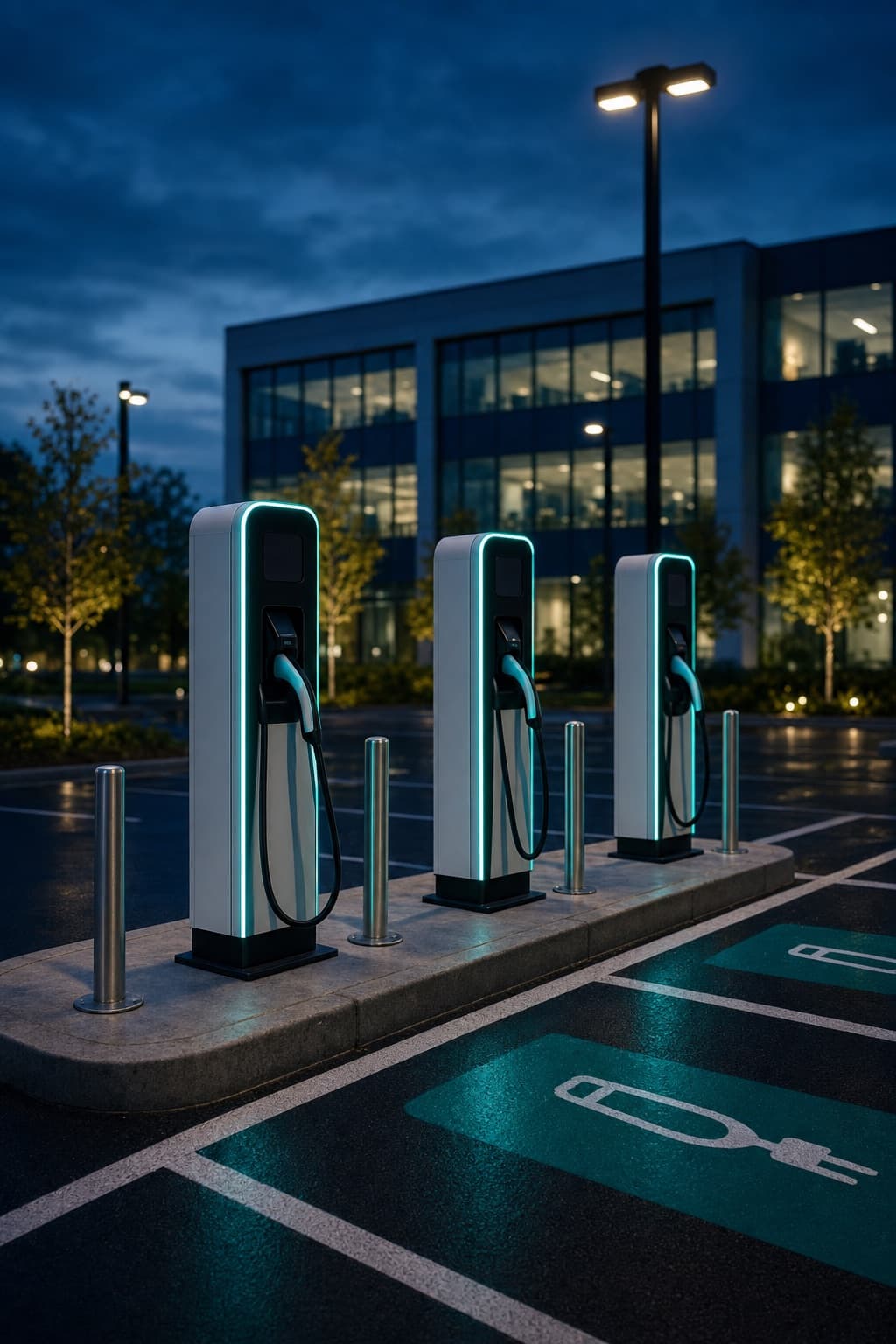
Commercial EV charging: ports, load management and the years after installation
A commercial project is not a bigger version of a home installation. The decisions that matter are how many ports the site can actually run at once, who pays for the electricity, and what the equipment costs to operate in the years after the electrician leaves.
Ports the service can run, versus ports installed
The first number a commercial buyer asks for is how many chargers can be installed. The more useful number is how many can run simultaneously at full output without exceeding what the service can supply, and those two numbers are rarely the same.
Load management is what closes the gap. Equipment that shares a capacity allocation across several ports lets a site install more than its peak capacity would otherwise allow, at the cost of slower charging when everything is plugged in at once. For a workplace where cars sit for eight hours, that trade is usually invisible. For a customer lot where cars sit for forty minutes, it is not.
The site work nobody budgets for
In a parking lot, the electrical work is often the smaller half. The rest is civil.
- Trenching or directional boring from the service to the parking area, and reinstatement of asphalt or concrete afterwards.
- Bollards or wheel stops protecting equipment from vehicles.
- Lighting, if the spaces will be used after dark.
- Signage and space marking.
- Accessibility requirements applying to parking and to the equipment itself.
Networked or not
Networked chargers report usage, authenticate users, take payment and can be managed remotely. They also carry a subscription, and that cost continues for as long as the equipment is in service.
The question is what the site actually needs. Charging staff at a workplace with no billing may need nothing more than reliable equipment and a way to see whether it is working. Charging customers or the public means authentication and payment, and that means a network.
Worth asking before signing: what happens to the equipment if the network provider changes terms or ceases operating, and whether the hardware can be repointed to another network.
The years after installation
Public and semi-public charging equipment lives outdoors, is used by people who did not buy it, and fails in ways that are invisible until somebody complains.
- Who is responsible for uptime, and how is a fault detected, by monitoring, or by a phone call from an annoyed driver?
- What is the response time when a port fails, and is it contractual?
- Who replaces a damaged connector or a cut cable, and how quickly?
- What is the expected service life of the equipment, and what is the plan when it reaches it?
These are the questions that separate a charging installation from a charging service. The electrical part, capacity, circuits, protection, is covered on the panel page and the requirements page.
Frequently asked
How many chargers should a workplace install?
Fewer, well-managed, and with conduit run for expansion, beats a large installation the service cannot support. The right number comes from the fleet or staff profile and from what the service can carry, not from a round figure.
Can we charge employees or customers for electricity?
Technically yes, with networked equipment. Whether and how you may resell electricity is a regulatory question that varies by state. [To be verified against state rules before publication.]
Is it cheaper to install everything at once?
The civil work, trenching, conduit, reinstatement, is far cheaper done once. Installing conduit and capacity for future ports while the ground is open is usually the best value decision in a commercial project.
Last reviewed July 29, 2026.
Scope the site
Parking layout, service capacity, how many ports and who uses them. Providers who do commercial work price the civil scope and the operating model, not just the chargers.
Level 2 Charge Pro installs Level 2 charging equipment: the dedicated 240-volt circuit, the panel work it depends on, the cable run, and the inspection that closes the job.