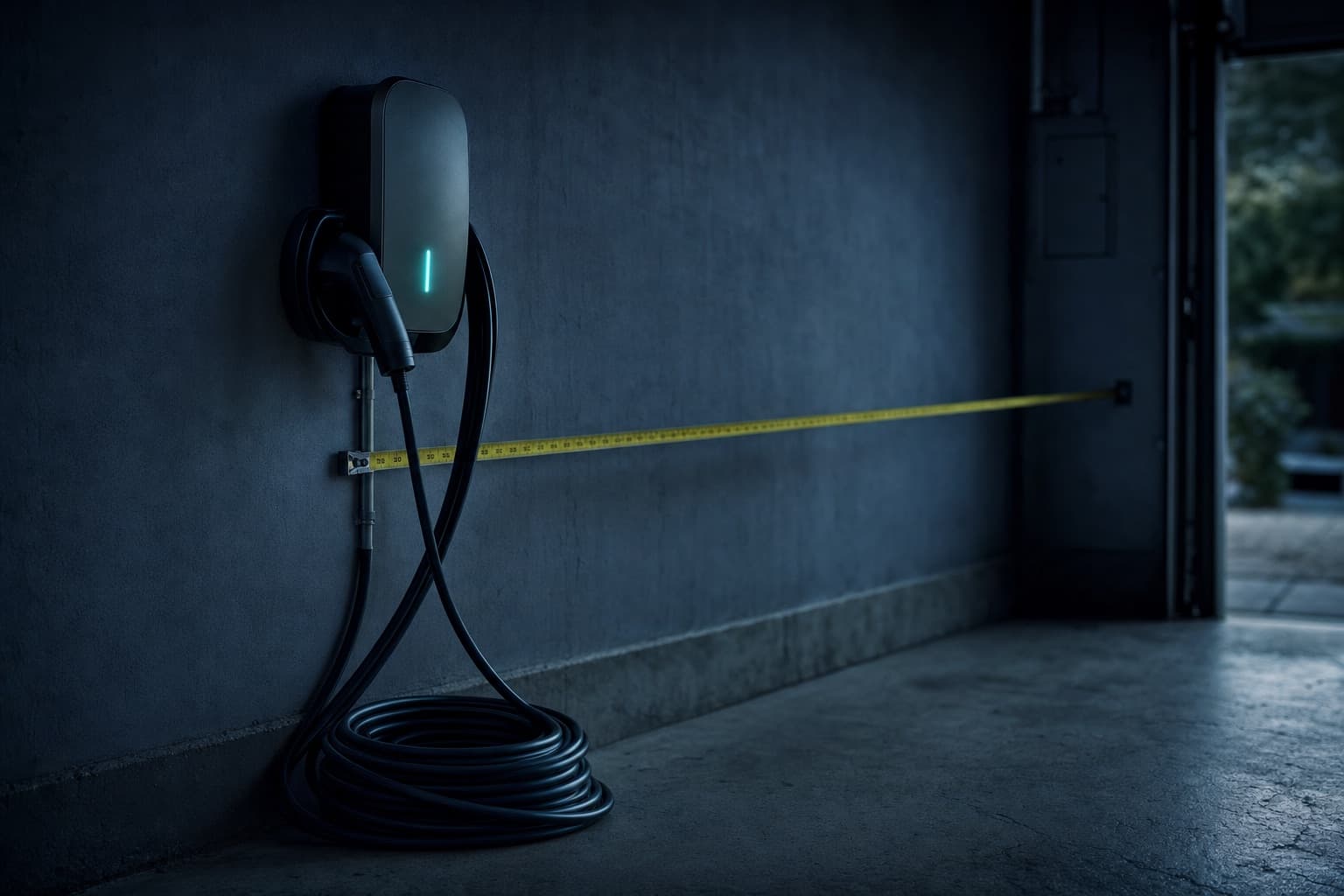
What drives the cost, and why the charger is rarely the answer
This page contains no price. Not because the number is secret, but because it is not one number, and a made-up average would become the anchor against which three real quotes are judged. What follows is every variable that moves it, and how to compare bids that do not look alike.
Why the charger is the cheap part
Buyers research equipment for weeks and then discover that two electricians quoting the same charger are hundreds or thousands of dollars apart. The equipment was never the variable. Labour, materials on the run, and whatever the panel demands are.
That is the inversion this whole site is built around. A charger fifteen feet from a modern panel with spare capacity is close to the cheapest electrical project a house can have. The same charger, on a full panel, a hundred feet away, across a driveway, is a different order of magnitude.
Neither of those is a good deal or a rip-off. They are different amounts of work.
The drivers, in rough order of influence
1. Whether the panel has room
Spare capacity, spare physical space and an adequate busbar mean a breaker goes in and the job proceeds. The absence of any of the three introduces a sub-panel, a load management device or a service upgrade, see the panel page. This single question separates the two price worlds.
2. Distance, and what is between
Cable and conduit cost money per foot, and labour costs far more per foot when the route is difficult. Fifty feet through an open, unfinished basement is not fifty feet through a finished ceiling in a two-storey house.

3. Indoors or outdoors
An outdoor installation needs equipment and enclosures rated for weather, and often a different mounting arrangement. Add a trench, and the project acquires excavation, a conduit, backfill and the reinstatement of whatever surface was on top.
4. What the walls are made of
An unfinished garage with exposed studs is the easy case. Masonry, finished drywall you care about, an occupied floor, or a run crossing a fire-rated assembly all add time and often add a second trade.
5. Permit, inspection and utility steps
Fees and processes vary widely by jurisdiction, and some utilities require notification or offer programs that come with their own paperwork. Both are cost and both are calendar, see permits and planning.
6. Equipment
Power rating, cable length, indoor or outdoor rating, and whether the unit is networked. Networked units may also carry a subscription, which is an operating cost rather than an installation cost and belongs in a different column.
Making two quotes comparable
Six questions, one email, sent to every bidder. This is the highest-value fifteen minutes in the whole project.
- Does this price include any panel work, and if the load calculation says an upgrade is needed, what happens to the price?
- How is the circuit routed, and is any drywall or surface repair included?
- Is the permit fee included, and who pulls it?
- What is the total run length assumed, and what happens if the actual route is longer?
- Is the equipment included at this price, and which model exactly?
- What is excluded, in one list?
A bidder who answers all six clearly is often the higher number on paper and the lower number on completion. Not a law of nature, but a reliable pattern.
Incentives, rebates and programs
Federal, state, local and utility programs exist and change frequently, in eligibility, in amount, and in whether they apply to equipment, installation or both. Some are administered by the utility and require pre-approval before the work is done, which makes them a sequencing question as much as a money one.
The practical advice that does not expire: ask your utility what applies before the work is scheduled, not after. Programs that require pre-approval do not pay retroactively.
Where money is genuinely wasted
- Buying equipment before anyone has looked at the panel. The capacity available decides what the circuit can be, and therefore what equipment is worth owning.
- Sizing for the maximum the equipment can do rather than what the vehicle accepts and the household actually needs.
- Positioning the charger where it looks tidy rather than where the cable reaches the port, then paying for it to be moved.
- Accepting a low bid that excludes the panel work everyone knew was coming.
- Skipping the permit and finding out at the point of sale of the house.
Frequently asked
Why is nobody willing to quote over the phone?
Because the two variables that move the price most, what the panel can take, and what the route to the parking space involves, cannot be seen down a phone line. Good electricians ask for photos of the panel and the parking area before quoting.
Is a more expensive charger worth it?
Sometimes, for cable length, outdoor rating, or genuinely useful scheduling features. Rarely for a power rating your vehicle cannot accept or your service cannot supply.
Should I install for a second vehicle now?
Running conduit or leaving capacity while the walls are open is far cheaper than a second project later. Whether the service can carry two chargers at once is a separate question, and load management is often the answer, see the panel page.
Last reviewed July 29, 2026.
Get the scope priced, not estimated
Parking, panel, distance and access. Those four decide the quote, and establishing them is our job rather than yours.
Level 2 Charge Pro installs Level 2 charging equipment: the dedicated 240-volt circuit, the panel work it depends on, the cable run, and the inspection that closes the job.